
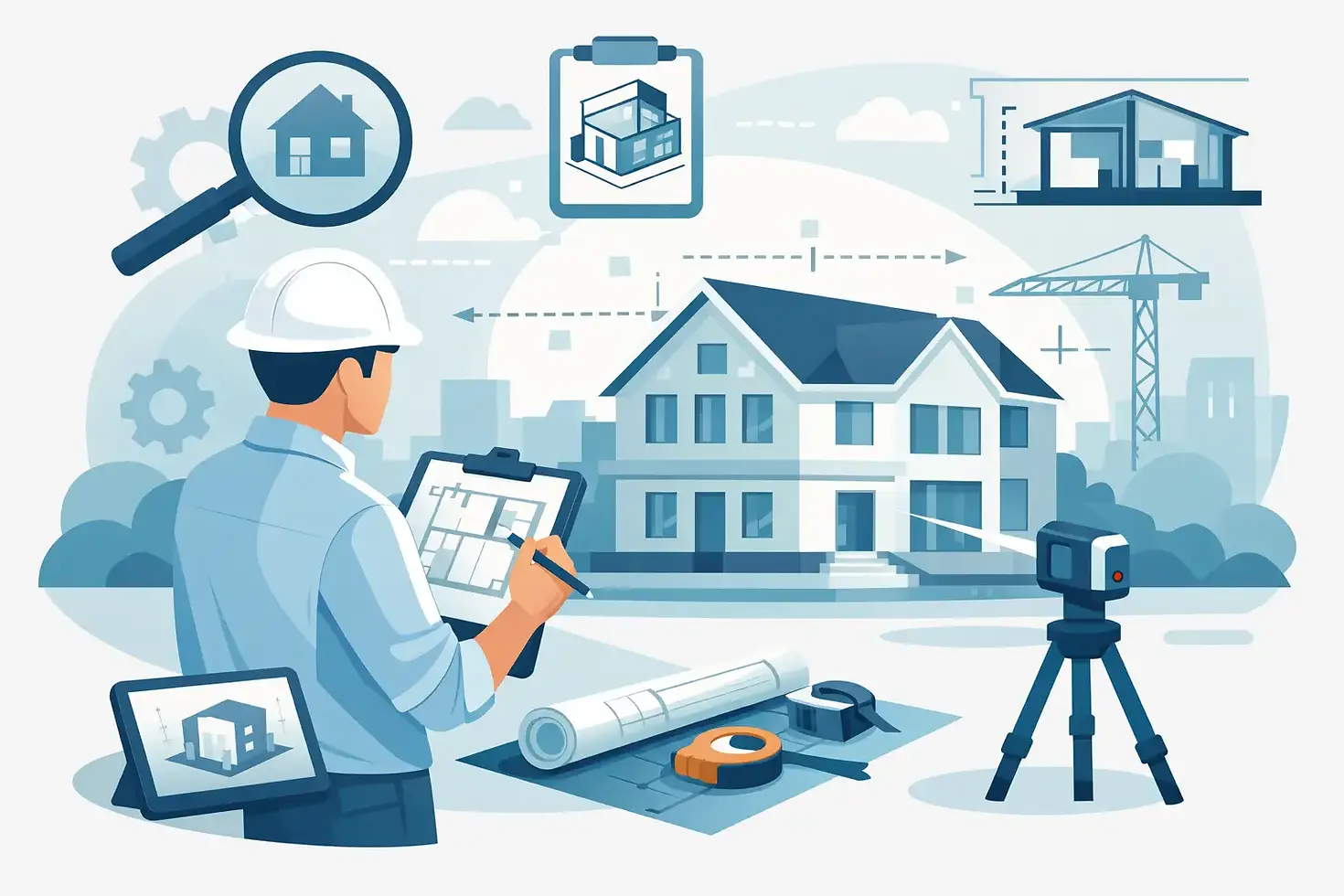
Architectural As Built Documentation Explained
- Space Captures Team

- Jun 23
- 5 min read
When an existing building has three different floor levels where the old plans show one, the problem is not design ambition. It is bad information. Architectural as built documentation exists to remove that uncertainty before design, planning, coordination or heritage work begins.
For architects and consultants, that means starting from dependable existing conditions rather than inherited drawings, partial hand measurements or site notes that leave too much open to interpretation. On straightforward projects, poor baseline information wastes time. On listed buildings, refurbishments and irregular structures, it can derail decisions completely.
What architectural as built documentation actually means
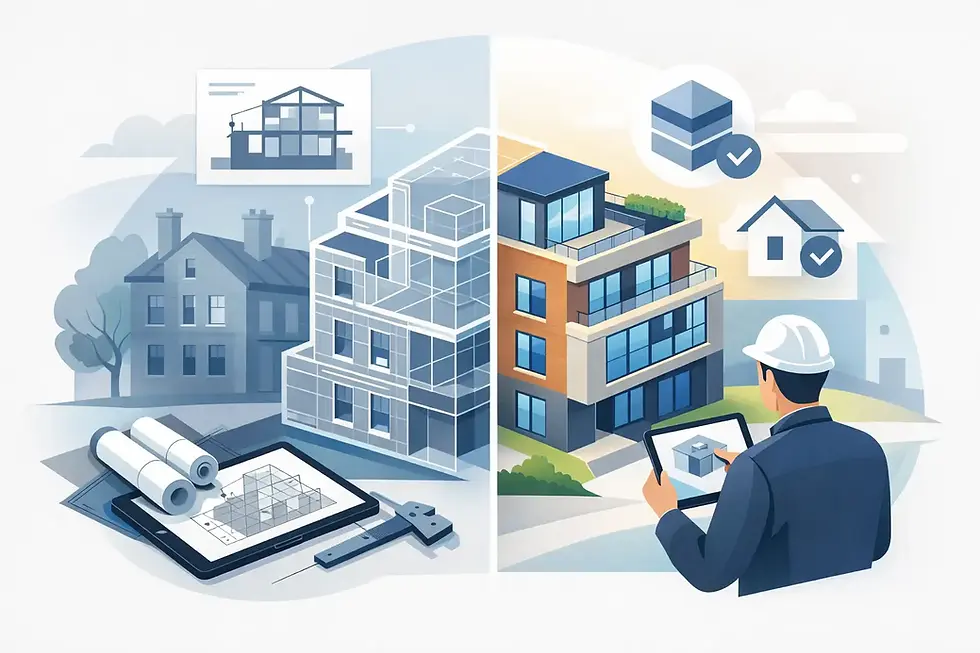
Architectural as built documentation is the measured record of a building as it exists on site, translated into usable design outputs. Depending on the brief, those outputs may include floor plans, elevations, sections, roof plans, reflected ceiling plans, external envelope drawings, point clouds and BIM or Revit models.
The key point is that this is not a rough record, and it is not simply a compliance exercise. Good as built documentation gives the design team geometry they can trust. It reflects actual built conditions, including movement, irregularity, historical alteration and the kinds of dimensional inconsistencies that often matter most once a project enters design development.
That distinction matters because many teams still receive "existing drawings" that are really just legacy plans with a few updates. They may be useful as references, but they are rarely dependable enough for coordination or detailed intervention. Proper measured documentation is produced from current site capture and checked outputs, not assumptions.
Why accuracy matters more than most teams expect
Most project risks linked to existing conditions do not announce themselves early. They appear later, when setting out a stair core, coordinating structure against services, developing joinery, or testing whether a new intervention can sit within an old fabric line without conflict.
A wall that is out by 60 mm may seem minor at survey stage. In a tight refurbishment, it can affect circulation widths, fire strategy, fitted furniture, service zones or planning drawings. In heritage settings, hidden distortion and non-standard geometry are often not exceptions. They are the building.
This is why precision-first architectural as built documentation pays for itself. It reduces redesign, avoids repeated site verification, and gives architects and technologists a more stable base to work from. It also saves internal production time. Teams should not have to spend hours repairing survey outputs before they can even begin design work.
There is, however, a practical trade-off. Not every project needs the same level of detail. Early feasibility may only require accurate plans and elevations, while technical design or prefabrication coordination may justify richer modelling and more extensive sectional information. The right scope depends on what decisions the documentation needs to support.
How architectural as built documentation is produced
The workflow usually begins with agreeing the required outputs, level of detail and tolerances. That sounds obvious, but it is where many documentation packages go wrong. If the survey brief is vague, the delivered files may be technically correct yet still not useful for the design stage ahead.
Once the scope is set, site capture is carried out using methods appropriate to the building and the required deliverables. For many projects, high-accuracy 3D laser scanning provides the most dependable basis because it records dense spatial data across complex geometry quickly and consistently. On simpler buildings, traditional measured survey methods may still play a role, but the choice should always be driven by the building and the output requirement rather than habit.
After capture, the raw data is registered, checked and translated into the agreed documentation set. That may be 2D CAD drawings, a point cloud, or a Revit model at a defined LOD. The quality difference appears here. Clean file structure, sensible layering, clear naming, model discipline and geometry that aligns with real site conditions all affect how useful the package is to the receiving team.
Fast turnaround is valuable, but only if it does not come at the cost of reliability. The best documentation workflows balance speed with rigorous checking so that architects receive files they can use immediately.
Where as built documentation often fails
The most common failure is not dramatic inaccuracy. It is incomplete scope. A survey may cover primary plans but miss roof geometry, ceiling variation, external levels, structural depth changes or the subtle distortions that become critical later.
Another issue is over-simplification. Buildings are often regularised in drawings to make them look tidy, especially when produced from limited site notes. That may be acceptable for a marketing brochure. It is not acceptable for design coordination. If a historic wall bows, if window heads vary, or if floor levels step unexpectedly, the documentation should reflect that.
Model quality can also be a weak point. Some BIM outputs are technically delivered as requested but lack the discipline needed for live project use. Misclassified elements, poor family choices, unclear datum logic and inconsistent geometry can create as much friction as missing information.
For design professionals, the real cost of these issues is downstream. Teams start second-guessing the base information, revisiting site repeatedly, or redrawing material internally. That is exactly what documentation should prevent.
Architectural as built documentation for complex and heritage buildings
Irregular buildings need specialist handling. A Georgian townhouse with later rear extensions, uneven floors and altered roof lines cannot be approached like a new-build shell. The same applies to churches, civic buildings, industrial conversions and listed properties where geometry has shifted over time and design intervention must respond carefully to the existing fabric.
In these cases, architectural as built documentation is not just about measurement. It is about interpretation without distortion. The survey team needs to understand which irregularities are incidental and which are architecturally significant. They also need to produce outputs that remain clear and usable, even when the building itself is anything but regular.
That is where experience with architecturally sensitive and difficult geometry makes a measurable difference. Specialist documentation teams are generally better at deciding where additional sections are needed, how to model non-standard forms, and how to represent deformation honestly without producing cluttered, impractical files.
Across England and Scotland, this is especially relevant in refurbishment and heritage work, where dependable records often support planning, conservation strategy and technical coordination at the same time.
Choosing the right deliverables for the job
Not every client needs the same package, and asking for everything can be as inefficient as asking for too little. The better approach is to match outputs to project stage and risk.
For early-stage appraisal, accurate plans, elevations and a point cloud may be enough. For coordination-heavy refurbishment, sections, roof plans and reflected ceiling information often become more important. If the design team is working in BIM, a structured Revit model can save significant internal time, provided it is built to an agreed LOD and intended use.
What matters is clarity at the outset. Are the drawings for concept design, statutory approvals, clash reduction, fabrication reference or long-term asset information? Each use case affects scope. A dependable documentation partner should be able to advise on that rather than simply taking an order.
What to expect from a dependable documentation partner
Design teams usually want the same things from survey support: accurate geometry, clear communication, clean outputs and no unnecessary friction. That sounds basic, yet it is still surprisingly rare.
A dependable partner should define scope clearly, explain what will be delivered, identify any access or visibility constraints early, and provide outputs in a format the project team can use without rework. Responsiveness matters too. Survey work often sits at the front of a programme, so delays there quickly affect everyone else.
This is where a boutique specialist approach has real value. Firms such as Space Captures focus on precision-first capture and design-ready outputs, particularly for complex, listed and irregular buildings where generic survey workflows often fall short. For architects, that usually means less internal checking, fewer surprises and a smoother route into design.
Architectural as built documentation is not glamorous, but it shapes everything that follows. When the starting point is dependable, design teams can move faster and make decisions with more confidence. If a project involves complexity, heritage constraints or tight tolerances, getting that foundation right is rarely the place to economise.


Comments