

Listed Building Laser Scanning Explained
- Space Captures Team

- May 1
- 6 min read
A listed building rarely gives you a clean starting point. Floors drift out of level, walls lean, rooflines wander, and what appears symmetrical on paper usually is not on site. That is exactly why listed building laser scanning has become such a useful starting point for architects, technologists and consultants working on heritage projects where dependable geometry matters.
When the existing fabric is protected, assumptions are expensive. A missed change in floor level, an unrecorded beam soffit, or an elevation drawn from incomplete site notes can affect planning, listed building consent, coordination and construction information later on. Laser scanning does not remove the need for professional judgement, but it gives the team a far stronger record of what is really there.
Why listed buildings need a different level of survey accuracy
Heritage projects are rarely difficult because they are old. They are difficult because they are irregular, sensitive and often poorly documented. Existing drawings may be decades out of date, based on hand measurement, or simply too limited for current design work. Even where a PDF set exists, it may not reflect later alterations, structural movement, hidden junctions or local distortions built up over time.
In a modern, repeatable structure, small survey gaps can sometimes be managed through standard detailing or straightforward site checks. In a listed property, those same gaps can have wider consequences. You may be designing around retained joinery, coordinating interventions within uneven rooms, or demonstrating minimal impact to historic fabric. The tolerance for guesswork is much lower.
That is where listed building laser scanning earns its value. Instead of relying on selective spot measurements, the scan captures dense spatial information across the building. This creates a dependable reference for plans, sections, elevations and models, especially where surfaces are warped, access is awkward or geometry is inconsistent.
What laser scanning actually provides on a heritage project
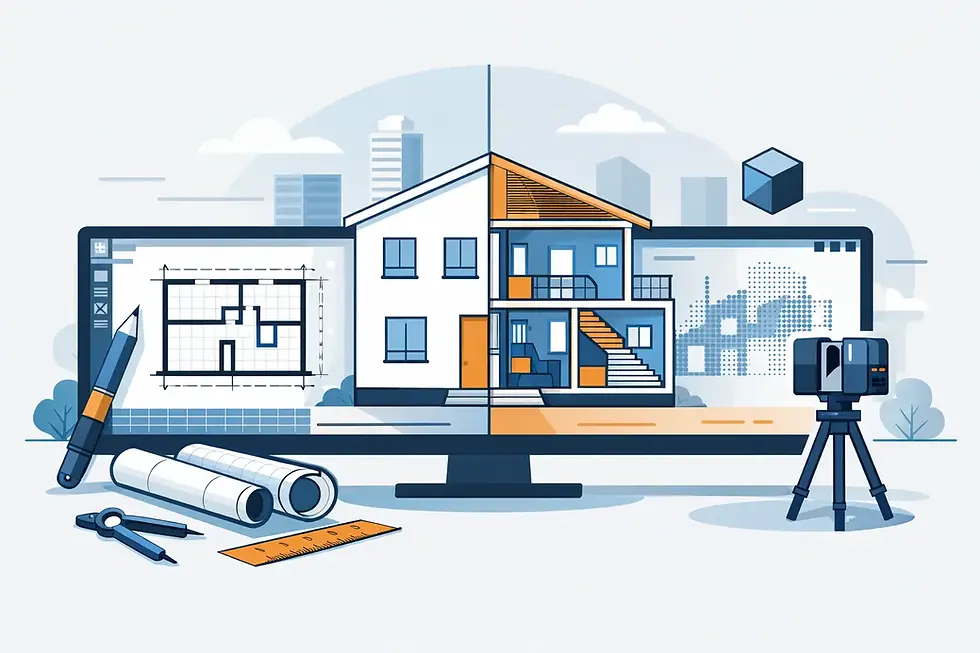
The scanner records millions of measured points across visible surfaces, building a point cloud that represents the existing conditions in three dimensions. On its own, that data is powerful but not always the end product a design team needs. The real value comes when the captured information is converted into structured outputs that fit the project workflow.
For some teams, that means accurate 2D floor plans, elevations, roof plans and sections extracted from the scan data. For others, it means a Revit model built to an agreed level of detail, using the point cloud as the geometric reference. The right output depends on what happens next. Early-stage feasibility, planning and listed building consent usually require something different from technical design or multidisciplinary coordination.
On a heritage scheme, that distinction matters. There is little point paying for a highly developed BIM model if the immediate need is a reliable drawing package for concept design. Equally, a basic drawing set may not be enough if the project involves complex roof geometry, services integration or structural coordination in a constrained existing shell. Good documentation starts with accurate capture, but it also depends on matching the deliverable to the design stage.
The practical advantage of listed building laser scanning
The most obvious benefit is accuracy, but accuracy is only useful when it reduces risk. On listed building work, that tends to happen in three areas.
First, it improves confidence at design stage. Teams can work from geometry that reflects the building rather than idealised assumptions. That is especially useful in spaces where walls are not parallel, timber has moved, or historic alterations have created compound irregularities.
Second, it cuts down repeat visits. Heritage sites often have constrained access, occupied areas, restricted zones and fragile elements that cannot be disturbed casually. A thorough scan provides a richer site record from the outset, which reduces the need to send someone back to verify another ceiling line, window reveal or stair geometry.
Third, it produces cleaner coordination later. If architects, structural engineers and specialist consultants are all referencing dependable base information, downstream clashes are easier to manage. That does not make the project simple, but it does remove one of the most common causes of avoidable rework.
Where listed building laser scanning needs specialist judgement
Not every scan is equally useful. Heritage work is not just about carrying equipment into an old building and pressing start. The challenge is understanding what must be captured, what can be modelled reliably, and how to document irregular fabric in a way that is practical for design teams.
For example, ornate features may need a different capture strategy from general room geometry. Tight roof voids, cellars, stair towers and service spaces can all affect scanner placement and data completeness. Reflective surfaces, low light and restricted access can also influence the survey methodology. If the team documenting the building does not understand the intended outputs, important geometry can be missed even when the raw scan coverage looks substantial.
That is why specialist experience matters on listed buildings. The issue is not just operating the scanner. It is knowing how listed fabric behaves geometrically, how to translate imperfect reality into dependable CAD or BIM outputs, and where the tolerances need to be tighter because design decisions depend on them.
Choosing the right outputs for heritage design work
A common mistake is to treat every listed building survey as if it needs the same deliverables. In practice, the best approach depends on the building and the project brief.
If the team is assessing redevelopment options or preparing a planning package, measured plans, elevations and a few well-chosen sections may be enough. If the work involves roof alterations, extension tie-ins or structural interventions, additional sectional information and roof documentation become more important. If multiple consultants need to coordinate in 3D, a Revit model based on the scan data can save substantial internal production time.
There is also a balance to strike between geometric faithfulness and model usability. A listed building is full of deviations, but not every bump or bow needs to become live model geometry. Sometimes a cleaner, controlled model supported by point cloud reference is the better design tool. Sometimes more explicit modelling of irregular features is justified because those conditions affect detailing, junctions or compliance. It depends on what the model is meant to support.
What architects and consultants should expect from the process
A good listed building survey process should feel clear from the start. That means agreeing scope early, identifying the required outputs, confirming tolerances, and understanding any access or heritage constraints before site work begins.
On site, the scanning itself is usually efficient and minimally intrusive compared with traditional measurement-heavy methods. The more significant part often happens afterwards, when the captured data is registered, checked and turned into usable documentation. For design teams, the priority is not simply receiving a point cloud. It is receiving drawings and models that are clean, legible and ready to use.
That point is worth stressing. Raw data without careful documentation still leaves design teams doing interpretive work under time pressure. The value of a specialist partner is in converting measured reality into dependable outputs that support design decisions immediately.
When listed building laser scanning may not be enough on its own
Laser scanning is strong on geometry, but it does not answer every project question. It will not tell you the construction sequence of a historic wall, the condition of concealed timbers, or the significance of every altered element. Heritage projects often need complementary inputs such as condition surveys, conservation advice, intrusive investigations or specialist structural assessment.
That is not a weakness of the method. It simply means geometry should be treated as one part of a wider evidence base. The advantage is that once reliable existing-condition information is in place, those parallel workstreams can proceed on firmer ground.
Why this matters before design starts
The earlier the building is captured properly, the better the design team can control risk. On listed work, delays and redesign often start with uncertainty that should have been resolved before concept layouts or coordination began. Inaccurate base drawings may seem manageable at first, but the cost usually appears later when details do not fit, planning information needs revision, or site discoveries force design changes.
Precision-first documentation changes that starting point. It gives the team a measured record they can trust, a clearer basis for design development, and fewer reasons to question the geometry halfway through the job. For practices working regularly with historic or architecturally sensitive buildings, that reliability is not a luxury. It is part of doing the work properly.
If a listed building is likely to challenge assumptions, the survey should do the opposite. It should give you clarity early, dependable outputs in the right format, and a cleaner foundation for every decision that follows.


Comments