

Laser Scanning vs Measured Survey
- Space Captures Team

- Jun 3
- 5 min read
A project can go off course before design work has properly started if the existing building information is unreliable. That is why the question of laser scanning vs measured survey matters so much. For architects, technologists and consultants, the right choice is not about buying the newest method. It is about getting dependable geometry, the right level of detail, and outputs your team can use immediately.
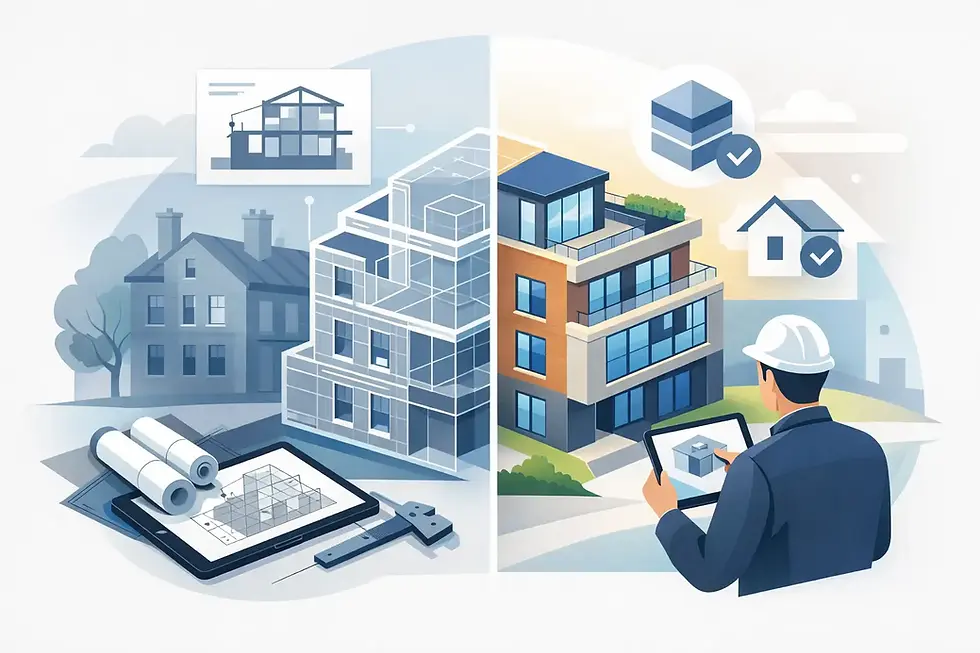
The short answer is that laser scanning and measured surveys are not always competing options. In practice, laser scanning is a capture method, while a measured survey is the documented output or service built from site measurement. The confusion starts when these terms are used as if they mean the same thing.
Laser scanning vs measured survey - what is the difference?
Laser scanning records existing conditions by capturing millions of spatial data points across a building or site. The result is a point cloud, which forms a highly detailed digital record of geometry. That data can then be processed into floor plans, elevations, sections, reflected ceiling plans, roof plans or Revit models.
A measured survey is the wider service of recording and documenting a building's dimensions, layout and physical features. It may be completed using laser scanners, total stations, hand measurement, photogrammetry, or a combination of methods. The deliverable is usually what the design team actually needs - accurate drawings or models of the existing building.
So if you are comparing laser scanning vs measured survey as though one replaces the other, it helps to reset the question. A more useful comparison is this: do you need laser scanning as the primary capture method for your measured survey, or can a more traditional measured approach achieve the right result?
When laser scanning is the better choice
Laser scanning is particularly strong where geometry is irregular, access is restricted, or the building contains a high volume of detail that would be slow and risky to capture manually. Heritage properties are a clear example. Uneven walls, distorted floors, leaning structures and ornate features rarely behave like the tidy assumptions found in old record drawings.
It is also well suited to refurbishment and retrofit work where coordination risk is high. If a team needs confidence around structure, openings, soffits, plant zones or complex roof forms, a point cloud creates a dependable geometric reference that can be revisited during design.
Speed on site is another advantage, though this needs context. Laser scanning can capture a large amount of information quickly, especially across multi-level or complex buildings. That does not always mean the entire process is faster overall, because office processing and modelling still take time. What it does mean is that the site visit is usually more efficient and less dependent on trying to predict every dimension that may matter later.
For projects that require BIM outputs, laser scanning often makes more sense from the outset. If the end goal is a Revit model at a defined level of development, the richness of the source data supports cleaner modelling decisions and reduces the need for repeat site checks.
When a traditional measured survey may be enough
Not every building needs a point cloud. If the property is small, relatively simple and the required output is limited to basic planning drawings, a traditional measured survey can be entirely appropriate. A straightforward residential unit, a modest retail fit-out or a regular-shaped office floor may not justify the extra depth of capture.
This is especially true where budget is tight and the design scope is limited. If the team only needs a set of floor plans and a couple of elevations, and the building does not present unusual geometry, a manually measured approach may deliver sufficient accuracy at lower cost.
The key phrase is sufficient accuracy. Over-specifying the survey can waste budget, but under-specifying it can be far more expensive once clashes, redesign or return visits begin to appear. That is where honest scoping matters.
Accuracy is not just about the equipment
One of the biggest misconceptions in the laser scanning vs measured survey discussion is that scanning automatically guarantees a better result. The scanner can capture excellent data, but the final quality still depends on survey control, registration, interpretation and documentation standards.
Likewise, a traditional measured survey is not automatically less accurate. In experienced hands, and within the right project scope, manual and instrument-based surveys can produce very dependable outputs. The issue is not simply which tool was used. It is whether the chosen method suits the building and whether the documentation team understands what level of precision the design process requires.
This matters most on listed buildings and architecturally sensitive sites. In those environments, errors often come from assumptions rather than missing dimensions. Bowed walls, non-square rooms and cumulative construction tolerances all need to be recorded honestly. A survey that looks neat but smooths out real irregularities can create serious downstream problems.
Output is what the design team actually buys
Most design professionals are not purchasing a scanner. They are purchasing certainty, or at least a controlled reduction in uncertainty. That is why the output specification matters more than the capture method in isolation.
If you need 2D CAD plans for feasibility, the survey strategy should support that. If you need coordinated sections through awkward roof geometry, the strategy changes. If your team is working in Revit and needs a clean existing-conditions model, the deliverable needs to be defined carefully from the start, including level of detail, modelling assumptions and file structure.
A useful survey partner will ask what you need to produce next, not just what building needs measuring. That conversation tends to reveal whether laser scanning is necessary, where traditional methods are adequate, and which areas need greater attention than others.
Cost, programme and risk
Cost is often where clients expect a simple answer, but the right answer depends on the risk profile of the project. Laser scanning can carry a higher upfront cost than a basic measured survey, especially if the requested outputs include detailed modelling. Yet on more complex projects, it often reduces overall project cost by cutting down revisits, clarification queries and drawing amendments.
Traditional measured surveys may look more economical for simple properties, and often they are. But if the building contains concealed complexity, that lower fee can prove misleading. A missed beam depth, a distorted stair core, or an irregular roof junction can cost far more in redesign time than the original survey saving.
Programme should also be looked at properly. Faster site capture does not always mean next-day drawings, because point cloud processing and model production are specialist tasks. Even so, where access is limited or a building must remain operational, reducing time on site can be a major advantage.
How to choose between laser scanning and a measured survey
The most reliable starting point is to look at the building, the next design stage and the consequences of getting it wrong. A simple shell for a light-touch fit-out has very different documentation needs from a listed property heading into detailed coordination.
Ask whether the building has irregular geometry, whether inaccessible areas matter to the design, whether you need BIM-ready outputs, and whether future design decisions are likely to depend on revisiting site conditions digitally. If the answer to several of those is yes, laser scanning is usually the stronger foundation.
If the project is modest, the geometry is predictable and the outputs are limited, a traditional measured survey may be the more proportionate choice. There is no value in paying for data depth that no one will use.
In practice, the best solution is often a blended one. A specialist documentation team may use laser scanning for complex areas and combine it with measured verification, control data and targeted interpretation to produce design-ready drawings. That is usually where the strongest results come from - not from choosing a side, but from matching method to purpose.
For architects and consultants working in refurbishment, heritage and complex existing buildings, the decision is rarely about technology for its own sake. It is about whether the information arriving on your desk is accurate enough to trust. If a survey gives your team cleaner coordination, fewer assumptions and a more confident starting point, it has done its job well.


Comments